


Flow Wrappers for Sale in Australia

Updated: Jul 7

How to Choose the Right Horizontal Flow Wrapper for Your Production
Purchasing a horizontal flow wrapper is a significant investment, and choosing the right machine involves far more than comparing purchase price or maximum speed.
After more than 25 years working as a flow wrapping technician and helping Australian food manufacturers select, install, commission and support horizontal flow wrappers, I've found that the businesses with the best long-term results are those that first understand which category of machine best suits their production requirements.
The biggest mistake we see is businesses comparing individual machines before deciding which category of flow wrapper is actually right for their production. Not every flow wrapper is designed for the same production environment, and selecting the wrong category of machine can lead to unnecessary downtime, limited flexibility, higher operating costs, or a machine that simply cannot grow with your business.
In this guide, we'll compare the major categories of horizontal flow wrappers available in Australia, explain where each type performs best, and help you understand the engineering, operational and commercial factors that should influence your decision before requesting quotations.
If you're still in the early stages of evaluating a flow wrapper, you may also find our Flow Wrapper Evaluation Guide useful. It provides a practical checklist of the key factors to consider before comparing quotations or speaking with suppliers.
Which Type of Horizontal Flow Wrapper Is Right for Your Business?

Choosing the right flow wrapper starts with understanding the different categories available.
Although most horizontal flow wrappers perform the same basic packaging function, they have been engineered for very different production environments. Some prioritise affordability and simplicity, while others focus on rapid changeovers, modified atmosphere packaging (MAP), high production speeds or fully automated production lines.
Rather than comparing individual machine models immediately, start by identifying which category best suits your products, production volumes and future growth plans. Once you've selected the right category, comparing individual machine models becomes much easier.
Industrial Entry-Level Horizontal Flow Wrappers
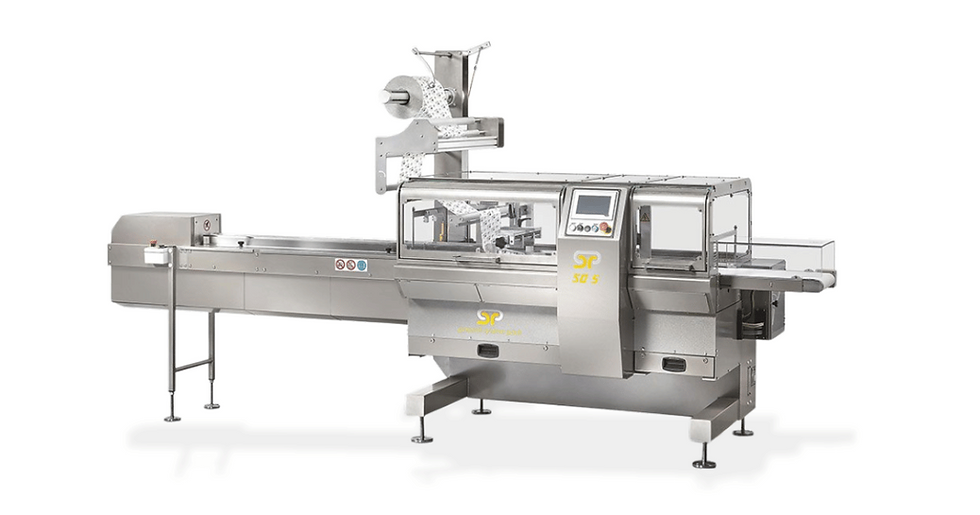
Industrial Entry-level horizontal flow wrappers are ideal for businesses purchasing their first machine or replacing older manually operated equipment. They provide reliable packaging at a lower capital investment and are well suited to single-product production with modest throughput requirements.
Our entry-level range includes three models designed to suit different product sizes, production volumes and future growth. Click on any machine below to learn more.

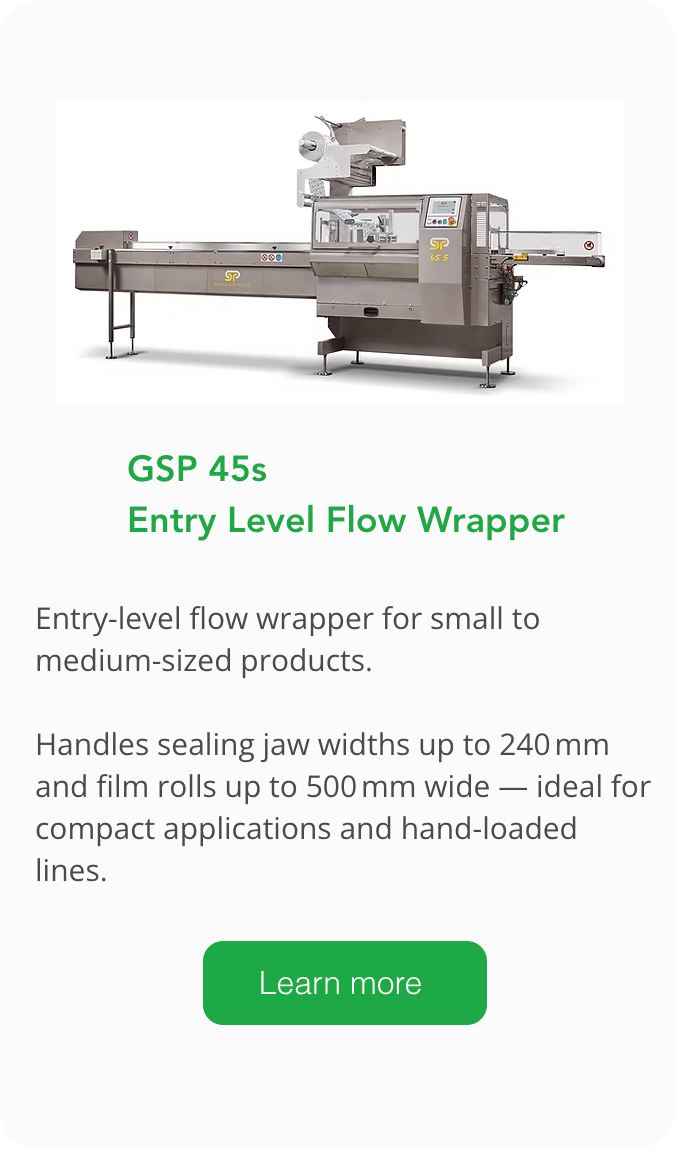

Who Should Choose an Industrial Entry-Level Flow Wrapper?
One of the biggest mistakes I see is businesses trying to compare machine models before deciding what type of production they actually need. In many cases, an industrial entry-level horizontal flow wrapper is more than capable of delivering reliable packaging for years, provided it matches the application.
These entry-level flow wrappers are generally best suited to manufacturers producing a relatively stable range of products with modest production volumes. They are particularly popular with bakeries, confectionery manufacturers, fresh produce packers and businesses purchasing their first automated packaging machine.
If your products are similar in size, production runs are reasonably consistent and frequent format changes are not required, an entry-level machine can provide excellent value while keeping operation simple and maintenance costs low.
However, if you expect to introduce multiple new products, run several packaging formats each day or significantly increase production over the next few years, it may be worth considering a more flexible medium-range machine from the outset. Spending a little more initially can often reduce future upgrade costs and minimise production interruptions as your business grows.
Medium-Range Horizontal Flow Wrappers

Medium-range horizontal flow wrappers are designed for manufacturers requiring higher production speeds, greater throughput and the durability needed for continuous production. They are ideal for businesses that have moved beyond their first flow wrapper and require a machine capable of operating reliably across multiple shifts.
While entry-level flow wrappers are often the most flexible choice for businesses packaging a wide variety of products, medium-range machines are engineered for higher output, increased reliability and easier integration into automated packaging lines. They are particularly well suited to manufacturers producing larger production volumes of the same products, where efficiency, uptime and long-term reliability become the priority.
Our medium-range range includes three industrial flow wrappers designed for demanding production environments and future automation. Click on any machine below to learn more.


Who Should Choose a Medium-Range Horizontal Flow Wrapper?
One of the most common mistakes I see is manufacturers purchasing an entry-level flow wrapper simply because it has enough speed for today's production. While that may solve the immediate requirement, businesses expecting significant growth often find themselves replacing the machine much sooner than anticipated.
Medium-range horizontal flow wrappers are best suited to manufacturers running larger production volumes of the same products over extended production shifts. They are designed for businesses where production efficiency, machine uptime and long-term reliability have become more important than maximum flexibility.
These machines are also an excellent choice for manufacturers planning to automate in the future. Models such as the GSP 55s and FP020s can be integrated with automatic feeding systems, reducing labour requirements while improving production consistency and throughput as production grows.
If your business expects increasing production volumes, longer operating hours or future automation, investing in a medium-range flow wrapper from the outset can often provide a lower total cost of ownership over the life of the machine.
Want to compare these machines in more detail? Explore our complete range of Medium-Range Horizontal Flow Wrappers.
Box Motion Horizontal Flow Wrappers

Box motion horizontal flow wrappers are designed for products that require longer sealing times or stronger seal integrity than can typically be achieved with rotary jaw machines. Rather than prioritising maximum speed, these machines focus on producing high-quality seals on demanding packaging applications.
They are commonly used with barrier films, modified atmosphere packaging (MAP), larger products and applications where seal quality is critical. The box motion sealing system moves with the product during sealing, increasing dwell time while reducing stress on the packaging film.
Our box motion range includes machines for stand-alone production as well as fully automated packaging lines. Click on any machine below to learn more.


Who Should Choose a Box Motion Flow Wrapper?
One of the most common misconceptions is that a box motion flow wrapper is simply a more advanced version of a rotary jaw machine. In reality, the two technologies are designed for different packaging requirements.
A box motion horizontal flow wrapper is the right choice when seal quality is more important than achieving the highest possible production speed. By moving with the product during the sealing process, the sealing jaws provide a longer dwell time, allowing stronger and more consistent seals to be produced on demanding packaging materials.
Box motion flow wrappers are commonly used for modified atmosphere packaging (MAP), barrier films, thicker laminates and larger or heavier products that require reliable hermetic seals. They are also well suited to products packaged in trays, cartons or gusseted bags, where maintaining package integrity is critical to product quality and shelf life.
As manufacturers increasingly adopt more sustainable packaging materials, box motion technology has also become an excellent solution for many recyclable, paper-based and compostable films.
These environmentally friendly materials often require longer sealing times and more controlled heat transfer to produce reliable seals without damaging the packaging. If sustainability is an important part of your packaging strategy, you may also find our guide to Paper Flow Wrappers in Australia useful.
If your products require high seal integrity, longer sealing times or premium packaging quality, investing in a box motion flow wrapper will often deliver better long-term performance than selecting a higher-speed rotary machine.
Want to compare these machines in more detail? Explore our complete range of Box Motion Horizontal Flow Wrappers.
High-Speed Horizontal Flow Wrappers

High-speed horizontal flow wrappers are designed for manufacturers where maximum production output, reliability and uptime are critical to business performance. These machines are built for continuous production environments where even small improvements in efficiency can have a significant impact on operating costs.
Rather than focusing on packaging a wide variety of products, high-speed flow wrappers are typically configured to run a smaller number of products at consistently high production speeds. Their heavy-duty construction, precision servo control and robust mechanical design make them well suited to multi-shift manufacturing and large-scale food production.
Our high-speed range includes industrial flow wrappers capable of integrating into fully automated packaging lines. Click on any machine below to learn more.


Who Should Choose a High-Speed Flow Wrapper?
High-speed horizontal flow wrappers are designed for manufacturers where production efficiency directly affects profitability. Businesses producing large volumes of the same products over multiple shifts can often justify the additional investment through increased throughput, reduced labour costs and improved overall equipment efficiency.
These machines are commonly used by large bakeries, biscuit manufacturers, confectionery producers, snack food manufacturers and contract packers where production speeds often exceed 250 packs per minute and downtime must be kept to an absolute minimum.
While entry-level and medium-range flow wrappers offer excellent flexibility, high-speed machines are engineered for consistent production rather than frequent product changeovers. If your priority is achieving maximum output with exceptional reliability, a high-speed flow wrapper is often the most appropriate solution.
Want to compare these machines in more detail? Explore our complete range of High-Speed Horizontal Flow Wrappers.
Fully Automatic Flow Wrapper Lines
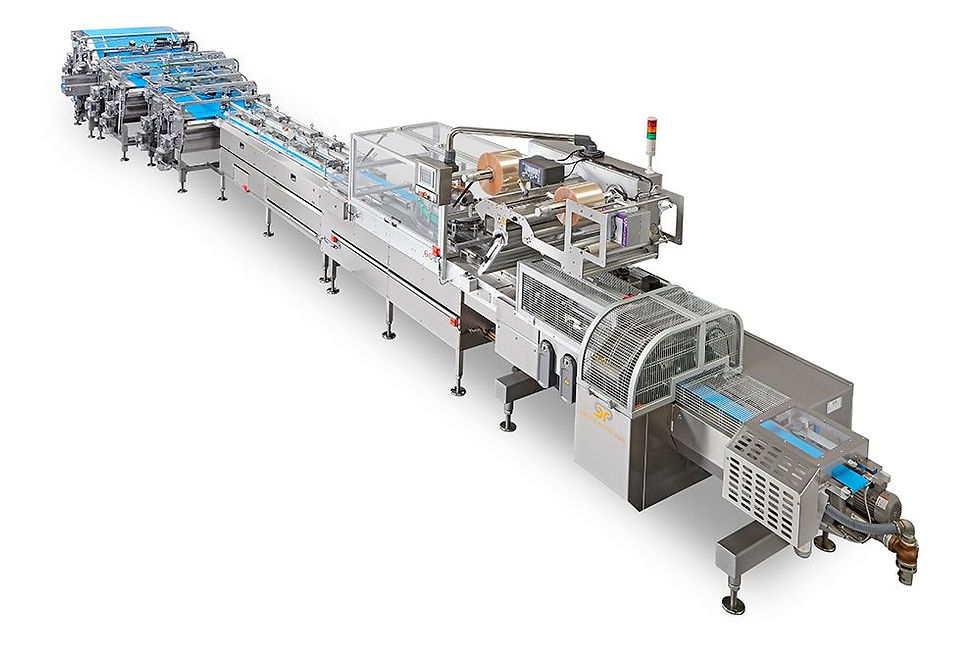
Fully automatic flow wrapper lines are designed for manufacturers producing very high volumes where manual loading is no longer practical. Rather than focusing solely on the flow wrapper itself, these systems combine automatic product feeding, alignment, spacing and packaging into a single integrated production line.
They are typically used by large food manufacturers producing products such as biscuits, chocolate bars, snack foods, bakery products and frozen foods, where maintaining consistent throughput with minimal labour is essential.
Depending on the application, these systems can include robotic loading, smart conveyors, vision inspection, reject systems, checkweighers, metal detectors, or other packaging machinery like cartoners, case packers and palletising equipment. Every line is engineered around the product, factory layout and production requirements to maximise efficiency and minimise downtime.
Unlike stand-alone flow wrappers, fully automatic packaging lines are custom engineered rather than selected from a standard catalogue. The flow wrapper becomes one component within a complete automated packaging solution designed specifically for the customer's production process.
Click on any automatic packaging line below to learn more.


Key Factors to Consider Before Buying a Flow Wrapper
Selecting the right horizontal flow wrapper involves much more than comparing speeds or prices. Before investing, consider how the machine will suit your products, production requirements and long-term business goals.
Product Range
Consider not only the products you manufacture today, but also those you may produce in the future. A machine that accommodates multiple product sizes and packaging formats can often provide better long-term value than one designed for a single application.
Production Requirements
Rather than focusing on maximum packs per minute, consider the production speed you need to achieve consistently while maintaining reliable sealing performance, product quality and minimal downtime.
Packaging Materials
Different films require different sealing characteristics. Barrier laminates, paper-based packaging, recyclable films and compostable materials may all influence the type of flow wrapper best suited to your application.
Automation
If you expect production volumes to increase, consider whether the machine can later
be integrated into automatic feeding systems or a complete packaging line.
Service and Support
Local technical support, operator training, spare parts availability and preventative maintenance often have a greater impact on long-term productivity than the purchase price alone.
The cheapest machine is not always the most economical. Reliability, uptime, maintenance costs and production efficiency all contribute to the true cost of ownership throughout the machine's life.

Why Choosing the Right Flow Wrapper Supplier Matters
Choosing the right flow wrapper is important, but choosing the right supplier can have an even greater impact on the long-term success of your investment.
An experienced supplier should do much more than simply sell a machine. They should understand your application, recommend the right equipment, commission and optimise the machine correctly, train your operators and continue supporting your business long after installation.
Before choosing a supplier, ask these five questions:
Does the supplier understand my application?
Will they commission and optimise the machine?
Is local technical support available?
Can the machine grow with my business?
Do they have experience with similar applications?
The cheapest quotation is not always the lowest long-term cost. Reliable support, local spare parts, operator training and practical experience often have a much greater impact on productivity than the purchase price alone. To help compare suppliers objectively, you may also find our Flow Wrapper Evaluation Guide useful.
Continue Your Research
Continue your research with these practical resources to help you compare machines, understand the technology and make a more informed purchasing decision.



Still unsure which horizontal flow wrapper is right for your application? Our engineering team can help you compare machine categories, evaluate your products and recommend the most suitable solution for your production requirements and future growth plans.
Final Thoughts
Choosing the right horizontal flow wrapper involves much more than comparing machine specifications or purchase prices. The best solution is one that matches your products, production requirements, packaging materials and future growth plans while providing the reliability, flexibility and support your business needs.
Whether you're investing in your first flow wrapper, upgrading to a higher-capacity machine or planning a fully automated packaging line, taking the time to understand the different machine categories will help you make a more informed long-term decision.
If you're still unsure which horizontal flow wrapper is right for your application, our engineering team can help you compare the available options, assess your products and recommend the most suitable solution for your production requirements and future growth plans.
About the Author

Ettienne van Vuuren is the Founder and Technical & Sales Director of PacMatix Pty Ltd and has more than 25 years of practical experience working with horizontal flow wrappers and automated packaging equipment.
Having started his career as a field service technician, Ettienne has commissioned, serviced and optimised flow wrappers across the bakery, confectionery, fresh produce, snack food and health food industries. Since founding PacMatix in 2017, he has helped Australian food manufacturers select, install and support many horizontal flow wrapper installations across Australia and Papua New Guinea.
His articles focus on helping manufacturers understand packaging technology, evaluate machinery objectively and make informed long-term investment decisions based on practical engineering experience rather than marketing claims.
Frequently Asked Questions About Flow Wrappers
1. What is a horizontal flow wrapper?
A horizontal flow wrapper is an automated packaging machine that wraps individual products in a continuous roll of heat-sealable film to create a sealed pillow pack. Horizontal flow wrappers are widely used throughout the food industry to package products such as bread rolls, biscuits, pastries, snack foods, confectionery, fresh produce and many other items. Modern servo-controlled machines can achieve highly consistent seals, fast changeovers and reliable production with minimal operator intervention.
2. What is the difference between an entry-level and a high-speed flow wrapper?
The main differences are production capacity, flexibility and automation. Entry-level flow wrappers are designed for businesses producing lower volumes or purchasing their first automated packaging machine. High-speed flow wrappers are built for continuous production, larger product ranges and higher output, often exceeding 250 packs per minute. Choosing the correct machine depends on your production requirements today as well as your expected future growth.
3. How much does a flow wrapper cost in Australia?
The price of a flow wrapper depends on the machine size, automation level, country of manufacture and optional equipment. Industrial Entry-level servo flow wrappers generally start from around AUD $70,000, while larger, fully automatic production lines can exceed several hundred thousand dollars. Low-budget flow wrappers are generally available below this price point but often involve compromises in engineering, flexibility and long-term performance. When comparing machines, it is important to consider the total cost of ownership rather than simply the purchase price, including reliability, service support, spare parts and long-term operating costs.
4. Which flow wrapper is best for a small business?
For many Australian small businesses, an Industrial entry-level servo flow wrapper provides the best balance between performance, reliability and investment. The ideal machine should be easy to operate, capable of handling future product changes and supported locally with spare parts and technical assistance. Purchasing a machine that can grow with your business often provides better long-term value than selecting the cheapest available option.
5. What products can be packaged on a horizontal flow wrapper?
Horizontal flow wrappers can package an enormous variety of products including bakery items, sandwiches, wraps, snack bars, biscuits, pastries, cakes, fresh produce, confectionery, frozen foods, pet treats, medical devices and many non-food products. The suitability depends on the product dimensions, shape, film type and required production speed.
6. Can one flow wrapper package multiple products?
Yes. Modern servo flow wrappers are designed to accommodate multiple product sizes and formats. Changeovers typically involve selecting a stored recipe, adjusting guides, changing the forming box if required and loading the appropriate packaging film. Machines designed for flexibility can significantly reduce setup times when running different products throughout the day.
7. What packaging films can a flow wrapper use?
Most flow wrappers can run a wide range of heat-sealable packaging films including polypropylene (BOPP), polyethylene laminates, PET laminates, recyclable mono-material films, compostable films and many paper-based packaging materials. The most suitable film depends on the product, required shelf life, sealing characteristics and presentation requirements.
8. Should I buy a new or refurbished flow wrapper?
Both options can provide excellent value depending on your production requirements and budget. A new flow wrapper offers the latest technology, maximum flexibility and a full manufacturer's warranty. A professionally refurbished machine can provide significant savings while still delivering reliable performance, provided it has been properly rebuilt, tested and supported by an experienced supplier.
However, it is important to remember that flow wrappers are highly customised to suit the products they package. Factors such as product dimensions, infeed configuration, sealing jaws, forming boxes, conveyors and product handling systems are often application-specific. As a result, it is relatively uncommon to find a used flow wrapper that is already configured for your particular product without requiring modifications or additional investment.
9. What should I look for when buying a flow wrapper?
When comparing flow wrappers, consider more than just price. Evaluate machine flexibility, reliability, ease of operation, safety, spare parts availability, local technical support, commissioning experience and the supplier's industry knowledge. A flow wrapper is a long-term investment, so ongoing support often becomes just as important as the machine itself.
10. How many packs per minute do I need?
The required production speed depends on your production volumes, labour availability and future growth plans. Purchasing a machine that operates comfortably above your normal production rate allows for product variations, maintenance periods and future expansion. Many manufacturers choose a machine with additional capacity to avoid outgrowing their equipment within a few years.
11. What safety features should a modern flow wrapper have?
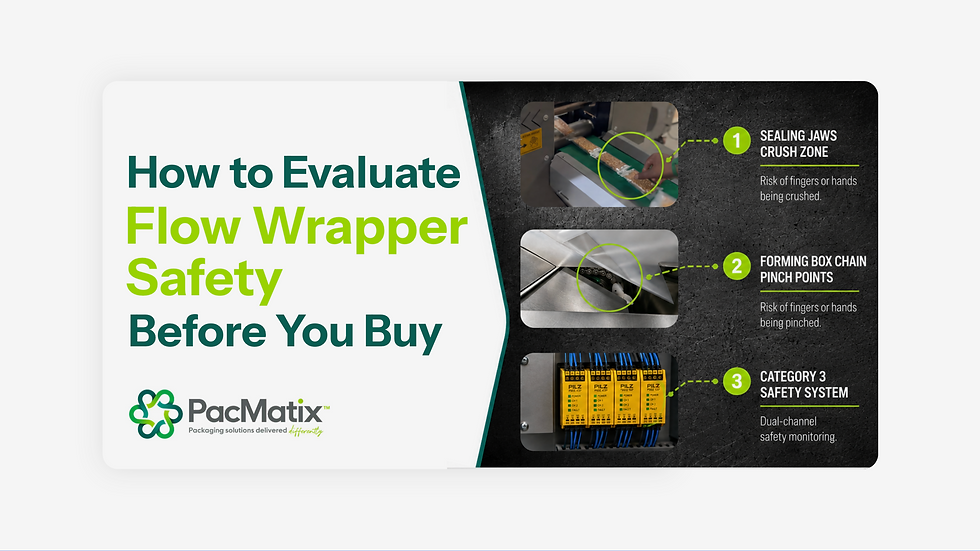
Modern flow wrappers should incorporate interlocked safety guarding, Category 3 or higher safety circuits, emergency stop systems and safe operator access during cleaning and maintenance. Machines supplied for the Australian market should comply with relevant Australian electrical and machinery safety requirements to ensure safe operation in production environments.
12. How important is local service and spare parts support?
Reliable local support is one of the most important factors when purchasing a flow wrapper. Even the highest-quality machinery requires servicing, preventative maintenance and occasional replacement parts throughout its life. Choosing a supplier with experienced technicians, stocked spare parts and responsive technical support can significantly reduce production downtime.
13. How long should a quality flow wrapper last?
A well-designed horizontal flow wrapper that is properly maintained can remain in production for twenty years or more. Regular servicing, preventative maintenance and using genuine replacement parts all contribute to maximising machine life while maintaining packaging quality and reliability.
14. Can a flow wrapper be upgraded in the future?
Many modern flow wrappers can be upgraded as production requirements change. Common upgrades include automatic feeders, printers, labelling systems, vision inspection, metal detection, checkweighing and additional product formats. Selecting a machine with upgrade capability allows businesses to expand production without replacing the entire packaging system.
15. Why choose an Australian flow wrapper supplier instead of buying directly overseas?
Purchasing through an experienced Australian supplier provides significant advantages beyond the initial machine sale. Local suppliers can assist with machine selection, product trials, installation, commissioning, operator training, spare parts and ongoing technical support. They can also ensure the equipment complies with Australian electrical and machinery safety requirements before it enters production, reducing risk and helping businesses achieve reliable long-term performance.
16. What is the difference between a low-budget flow wrapper and an entry-level flow wrapper?
A low-budget flow wrapper and an industrial entry-level flow wrapper are not the same thing. While the terms are often used interchangeably, they generally describe machines built to very different engineering standards.
Low-budget flow wrappers are typically designed to minimise the initial purchase price. This is often achieved through simplified electrical systems, lower-cost components, lighter machine construction and, in some cases, mechanical or partially servo-controlled designs. While these machines can be suitable for straightforward applications, they generally offer less flexibility, reduced repeatability, lower production reliability and fewer options for future upgrades.
An entry-level flow wrapper, on the other hand, is a professionally engineered production machine designed to provide industrial performance at a lower production capacity rather than a lower engineering standard. These machines typically feature full servo control, industrial-grade electrical components, stronger machine construction, improved safety systems and the flexibility to accommodate multiple products and future business growth.
As a general guide, low-budget flow wrappers are typically available for up AUD $60,000, while Industrial entry-level servo flow wrappers generally start from around AUD $70,000, depending on the machine specification and optional equipment. Although the initial investment is higher, many manufacturers find that improved reliability, flexibility, repeatability and lower operating costs provide significantly better long-term value over the life of the machine.


Comments