


Flow Wrapper Parts Explained -How a Flow Wrapper Works

Updated: Jul 14
A horizontal flow wrapper is made up of several key components that work together to wrap products efficiently and consistently. Understanding these parts is essential for correct setup, smooth operation, and effective troubleshooting.
In this guide, we explain the main assemblies of a flow wrapper and how they function within the packaging process.

Flow Wrapper Overview Video
This video provides a simple overview of the main components of a horizontal flow wrapper and how they work together during the packaging process.
Flow Wrapper Components Overview
A horizontal flow wrapper consists of a series of integrated assemblies that work together to wrap products in a continuous process.
From the infeed conveyor and film handling system through to the forming box and sealing jaws, each component plays a critical role in achieving consistent pack quality and high-speed performance.
Understanding these core sections helps operators optimise setup, reduce downtime, and maintain reliable production.
If you are unfamiliar with any of the terminology used throughout this guide, refer to our Flow Wrapper Glossary, a comprehensive reference explaining common flow wrapper terms, machine components and packaging terminology used throughout the flow wrapping industry.
The diagram below shows how these components are arranged within a typical horizontal flow wrapper.
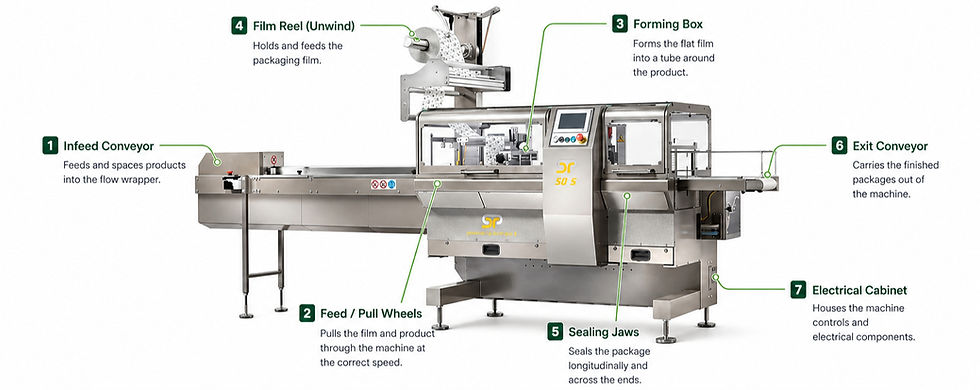

Main Parts of a Flow Wrapper
A typical horizontal flow wrapper is made up of several key assemblies, each responsible for a specific stage of the packaging process, from product feeding through to sealing and discharge.

Infeed Conveyor on a Flow Wrapper
Feeds products into the flow wrapper at a controlled spacing and orientation. Consistent product flow is critical for accurate timing into the sealing section and to prevent collisions or misfeeds.
Key Functions of the Infeed Conveyor
Controls product spacing
Sets timing into the machine
Directly affects seal consistency
Why the Infeed Conveyor Matters?
Poor product control can lead to product collisions, misfeeds, and inconsistent sealing. A properly configured infeed ensures accurate product spacing and timing into the sealing jaws, reducing waste and improving overall packaging line efficiency.


Feed / Pull Wheels
Pull the film and product through the flow wrapper at a controlled and consistent speed. These wheels are synchronised with the machine’s system to ensure the film and product move together without slipping.
Accurate pull wheel setup is critical for maintaining correct pack length, consistent film tension, and proper registration when running printed film.
Key functions:
Controls film feed and product movement
Maintains consistent pack length
Ensures correct print registration
Stabilises film tension through the machine


Forming Box
Shapes the flat film into a tube around the product as it moves through the machine. The forming box determines how the film wraps around the product and is critical to achieving a neat, consistent pack.
There are typically two types of forming boxes used in flow wrapping:
Fixed forming boxes — designed for a specific product size and film width
Adjustable forming boxes — allow operators to change height and width settings for different product formats
Correct setup is essential to avoid film wrinkling, poor tracking, or uneven seals, especially when changing product sizes or film types.
Key functions:
Forms flat film into a tube around the product
Sets the foundation for seal quality
Affects film tracking and alignment
Must be matched or adjusted to suit the product


Film Reel (Unwind Unit)
Holds and feeds the packaging film into the flow wrapper. The film reel (or unwind unit) ensures the film is delivered smoothly and under controlled tension as it enters the forming box.
Entry-level machines typically use a friction brake system to control film tension. Higher-end servo-driven flow wrappers use a motorised unwind system, which actively controls the film feed and maintains consistent tension throughout operation.
Consistent film tension is critical for stable performance.
Too much or too little tension can lead to poor tracking, misalignment, or inconsistent sealing.
Many modern machines are also equipped with automatic reel splicing systems, allowing a new reel of film to be joined without stopping production, reducing downtime and improving efficiency.
Key functions:
Holds and unwinds the packaging film
Maintains consistent film tension
Feeds film smoothly into the forming box
Enables continuous operation with automatic splicing (where fitted)


Sealing Jaws:
Seal the package and cut each individual pack as the product moves through the machine. The sealing jaws are responsible for both the end seals (cross seals) and the separation of each pack.
Sealing performance depends on a combination of temperature, pressure, and timing. If any of these are incorrect, it can result in weak seals, burnt film, or inconsistent pack appearance.
In practice, a large percentage of flow wrapper issues can be traced back to incorrect setup or adjustment of the sealing jaws. Small changes in temperature, pressure, or timing can have a significant impact on seal quality and overall machine performance.
In cases where seal pressure needs to be adjusted, it is best practice to use a carbon impression test to verify that pressure is evenly distributed across the sealing jaws. This process should be carried out by a trained technician, as incorrect adjustment can lead to uneven sealing, premature wear, or product damage.
You can learn more about this method in our guide:

There are typically two types of sealing systems used in flow wrappers:
Rotary jaws: used for high-speed applications, offering continuous motion and reduced mechanical stress
Box motion jaws: move in a controlled motion with the product, allowing for longer seal time and better performance on thicker or more complex films
Correct setup of the sealing jaws is critical to achieving strong, consistent seals and maintaining overall machine efficiency.
Key functions:
Creates the end seals on each pack
Cuts and separates individual packs
Controls seal strength and appearance


Exit Conveyor
Carries the finished packages away from the flow wrapper after sealingThe exit conveyor ensures a smooth and controlled discharge of products, preventing jams or product damage as packs leave the machine. A well configured exit conveyor is important for maintaining consistent flow into downstream equipment such as check-weighers, metal detectors, or packing stations.
Poor discharge setup can lead to product build-up, misalignment, or unnecessary stops, especially at higher production speeds.
Key functions:
Transfers finished packs out of the machine
Maintains smooth product flow after sealing
Prevents product build-up and jams
Feeds downstream equipment reliably

Electrical Cabinet
Houses the machine’s control system, including the PLC, servo drives, and electrical components that control the operation of the flow wrapper.
The electrical cabinet is responsible for synchronising all machine movements, from the infeed conveyor through to the sealing jaws, ensuring accurate timing, positioning, and overall machine performance.
Access to the electrical cabinet should be restricted to qualified personnel only. Incorrect adjustments or unauthorised access can lead to machine faults, safety risks, or damage to critical components.
Modern flow wrappers typically use advanced control platforms, allowing for precise adjustments, stored recipes, and integration with upstream and downstream equipment.
Key functions:
Controls and synchronises all machine movements
Houses PLC, drives, and electrical components
Enables recipe storage and machine setup
Supports integration with other packaging equipment

Conclusion: Understanding Your Flow Wrapper
A horizontal flow wrapper is a highly efficient and reliable packaging machine — but like any precision equipment, its performance depends on correct setup and a clear understanding of how each component works.
From the infeed conveyor through to the sealing jaws and discharge, every section plays a critical role in achieving consistent pack quality and maintaining high production efficiency.
In practice, most performance issues can be traced back to setup, adjustment, or wear in key areas such as film handling and sealing. Taking the time to understand these components helps operators reduce downtime, improve consistency, and get the best possible performance from their machine.
If you’re experiencing ongoing issues, looking to improve efficiency, or planning an upgrade, working with an experienced technician can make a significant difference.
👉 For more technical insights and troubleshooting guides, visit our KWIK TECH GEMS™ resource.
👉 If you need assistance with your flow wrapper, contact the PacMatix team for support across Australia.
Article written by: Ettienne van Vuuren – Founder, PacMatix (25 years hands-on flow-wrapper experience)
Published: May 2026
Frequently Asked Questions
1. What does a horizontal flow wrapper do?
A horizontal flow wrapper automatically wraps products in a continuous process using a roll of packaging film. The machine feeds the product through the wrapping area, forms the film around the product, seals the package, and cuts individual packs at high speed. Horizontal flow wrappers are commonly used for bakery products, snack foods, confectionery, protein bars, fresh produce, and many other packaged goods.2. What causes poor seals on a flow wrapper?
2. What causes poor seals on a flow wrapper?
Poor seals are often caused by incorrect sealing jaw setup, inconsistent film tension, incorrect temperature settings, worn sealing components, or poor product timing into the sealing section. In many cases, seal quality problems can be improved by checking sealing pressure, film tracking, and machine synchronisation. A carbon impression test is commonly used to verify even sealing jaw pressure distribution.
3. What is the purpose of a forming box on a flow wrapper?
The forming box shapes the flat packaging film into a tube around the product before sealing takes place. It plays a critical role in film tracking, pack appearance, and overall seal consistency. Incorrect forming box setup can lead to wrinkled film, poor alignment, or inconsistent seals.
4. What is print registration on a flow wrapper?
Print registration is the process of aligning the packaging film print with the product and sealing position. A sensor detects registration marks printed on the film to ensure logos, graphics, and pack artwork are positioned correctly on every package. Poor registration setup can result in off-centre printing or incorrect pack length.
5. What is the difference between rotary jaws and box motion jaws?
Rotary sealing jaws operate in continuous motion and are commonly used for high-speed packaging applications. Box motion jaws move with the product during sealing, allowing longer seal time and improved performance on thicker or more difficult packaging films. Box motion systems are often preferred for heavier products or paper-based packaging materials.
6. Why is film tension important in flow wrapping?
Consistent film tension is critical for stable machine performance, accurate print registration, and reliable sealing. Excessive or insufficient tension can lead to film tracking issues, inconsistent pack length, wrinkled film, or poor seals. Modern servo-driven flow wrappers often use motorised unwind systems to maintain stable tension throughout production.
7. How often should a flow wrapper be serviced?
Flow wrappers should be inspected and serviced regularly to maintain reliable performance and reduce unexpected downtime. Preventive maintenance typically includes checking bearings, belts, chains, sealing components, sensors, film tracking systems, and lubrication points. The required service interval depends on production hours, operating conditions, and the type of products being packaged.
Continue Learning About Flow Wrappers
Understanding flow wrapper terminology is only one part of selecting, operating and maintaining packaging equipment. If you're researching flow wrappers in more detail, the following resources provide additional technical guidance and practical buying advice.
Flow Wrapper Training – Access practical training resources covering flow wrapper setup, operation, troubleshooting, maintenance and best practices to help operators and maintenance teams improve machine performance.
Flow Wrapper Buying Guide – Learn how to evaluate different flow wrapper designs, engineering standards and supplier support before purchasing a machine.
Entry-Level vs Low-Budget Flow Wrappers – Understand why these commonly used terms describe different engineering philosophies and why the distinction matters when comparing machines.
Flow Wrapper Safety Guide – Learn about machine guarding, safety systems, risk reduction and the key safety considerations when operating horizontal flow wrappers.
Flow Wrapper Installations Across Australia & Papua New Guinea – Explore real customer installations across a wide range of food manufacturing applications.


Comments